
PW Developments — One of the most common misunderstandings among people considering property investment in Bali is the idea that a long-term lease is essentially the same as buying land.
It is not.
A leasehold arrangement can give an investor significant economic and contractual rights to use an asset for an agreed period. However, it does not automatically mean that the investor owns the underlying land permanently.
In practice, this distinction becomes particularly important when evaluating villas and other investment properties in areas such as Uluwatu, Bingin, Pecatu, Ungasan and the wider Bukit Peninsula.
For example, an investor may see a villa advertised for billions of rupiah and think:
“I am buying a villa worth billions of rupiah.”
But the more precise investment question is:
“What rights am I acquiring, for how long, over which asset, and what happens when that term expires?”
In other words, that is a fundamentally different way of looking at the investment.

…
Why the Distinction Matters
Indonesia has a specific land-rights framework.
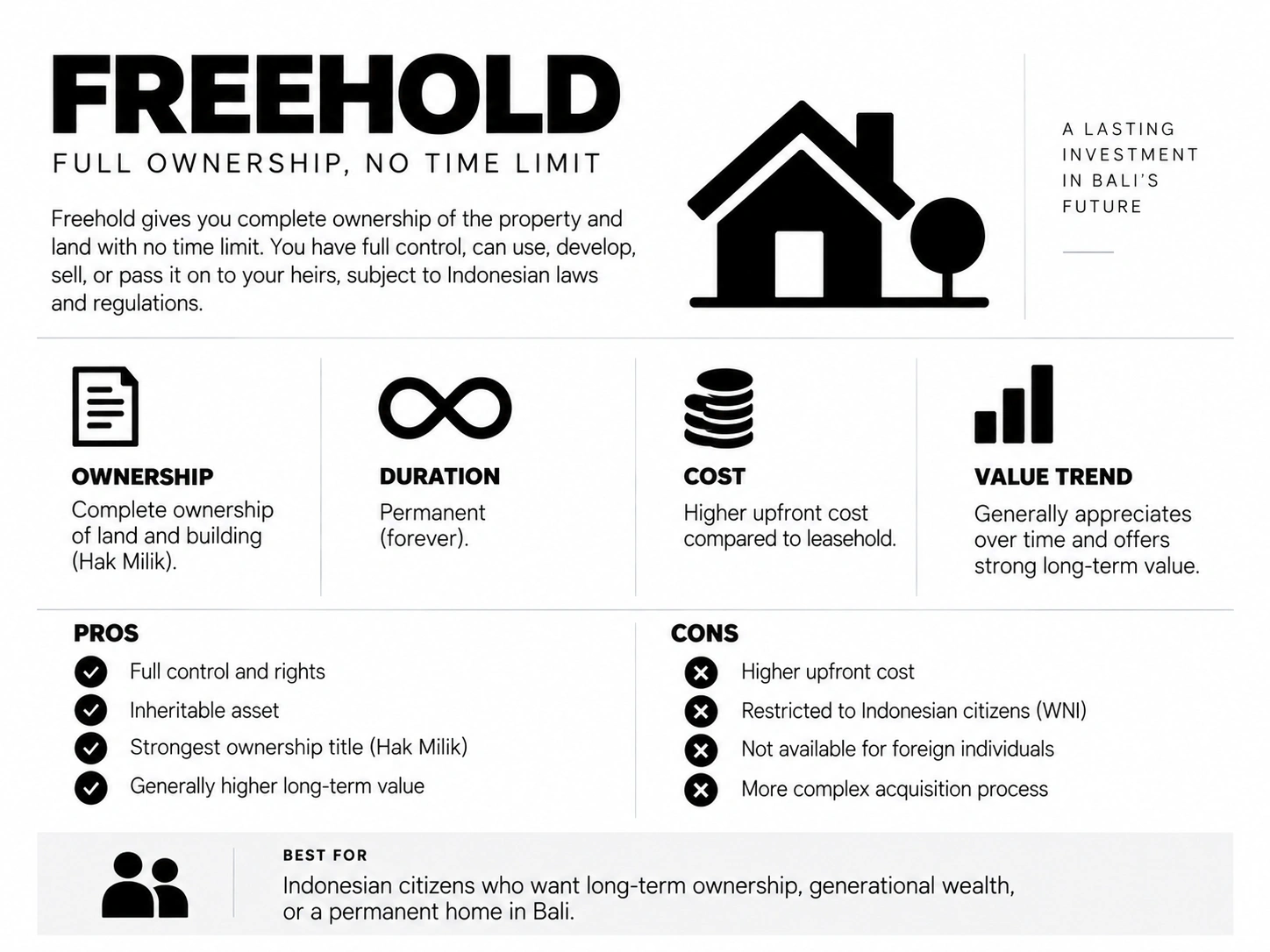
Under Indonesia’s Basic Agrarian Law, Hak Milik (Right of Ownership) is a distinct land right. Article 21 of Law No. 5 of 1960 states that only Indonesian citizens may hold Hak Milik, subject to the legal exceptions concerning certain designated legal entities.
Foreign investors therefore need to understand the difference between:
- acquiring a contractual lease over land or property;
- holding a qualifying right such as Hak Pakai;
- using an Indonesian legal entity that can hold certain land rights such as Hak Guna Bangunan (HGB); and
- simply owning the physical building or having contractual rights connected to it.
In other words, these are not interchangeable concepts.
Instead, the appropriate structure depends on the investor, intended use, business activity, property type and applicable Indonesian regulations.
For that reason, international investors should obtain independent advice from qualified Indonesian legal, tax and notarial professionals before entering into a transaction.
…
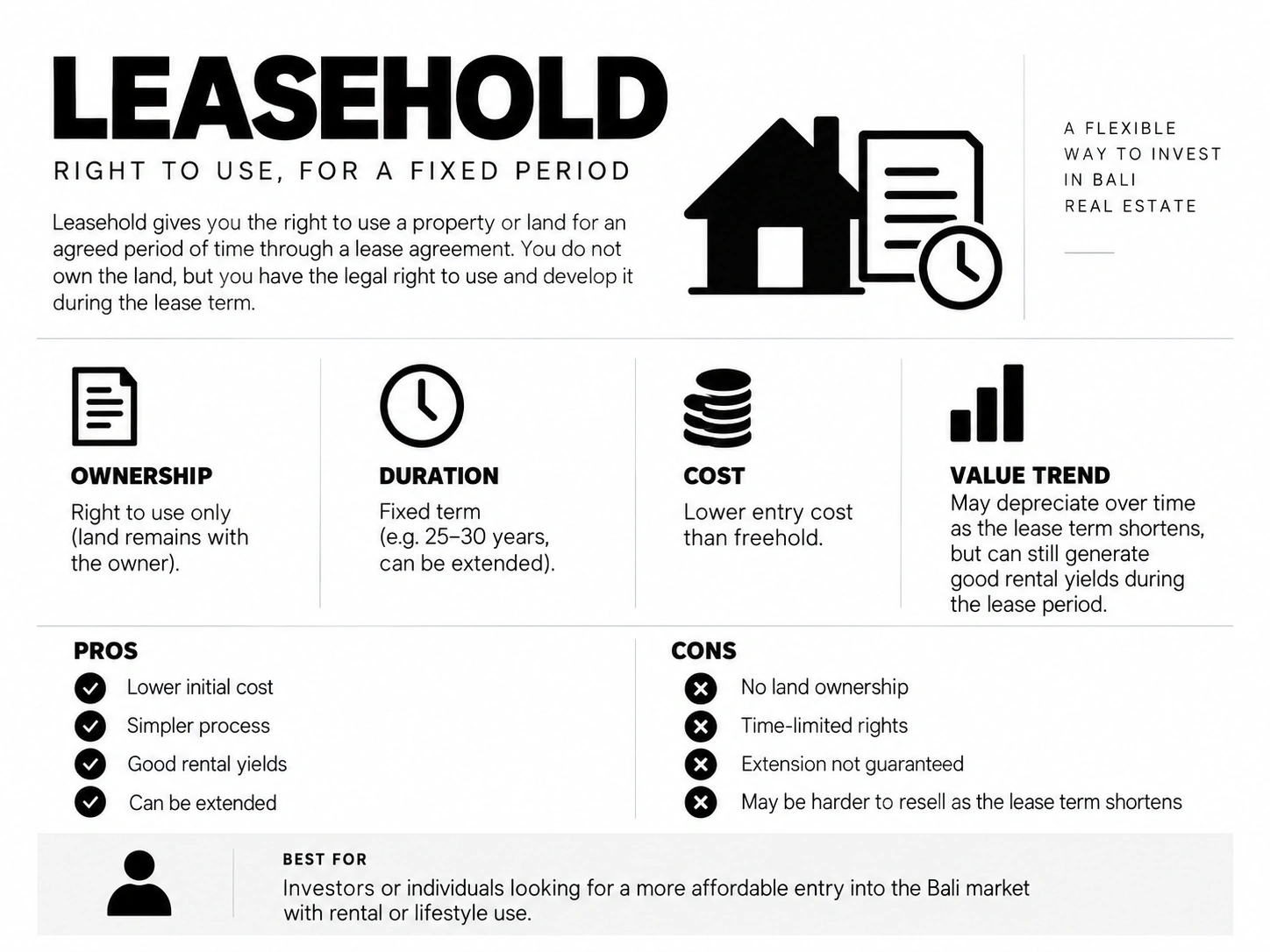
Leasehold Is a Right for a Period of Time
The simplest way to understand leasehold is to think about time.
For instance, suppose an investor enters into a 30-year lease for land and develops a villa on it.
In this scenario, the investor may have the contractual right to use the land and operate the agreed asset for the duration of the lease, subject to the terms of the agreement and applicable law.
But the investor does not thereby acquire permanent Hak Milik over the land.
Consequently, this creates an important distinction:
- Freehold/Hak Milik: ownership right in the land, where legally available.
- Leasehold: contractual right to use the land/property for an agreed period.
- Hak Pakai: a statutory land right with its own legal framework and duration.
- HGB: a statutory right to build and hold buildings on land, available to qualifying subjects under Indonesian law, including Indonesian legal entities established and domiciled in Indonesia, subject to applicable requirements.
Specifically, Indonesia’s current framework for land rights is principally governed by Government Regulation No. 18 of 2021 on Management Rights, Land Rights, Condominium Units and Land Registration. Notably, the regulation remains in force and replaced earlier regulations including PP No. 40/1996 and PP No. 103/2015.

…
A Simple Example: Why “I Own a Rp10 Billion Villa” Can Be Misleading
Consider this hypothetical investment:
Land + villa value: Rp10 billion
Lease term: 30 years
For example, an investor should not automatically describe the situation as:
“I own a Rp10 billion property.”
A more accurate way to think about it is:
“I have acquired contractual and economic rights to use and benefit from this property for the remaining lease term.”
As a result, that difference becomes increasingly important as the lease approaches expiry.
For example, imagine the same property has:
30 years remaining vs 15 years remaining vs 5 years remaining.
The physical villa might be exactly the same, land might be exactly the same, and location might be exactly the same.
But the economic proposition can be very different because the buyer is acquiring a different amount of remaining contractual time.

…
Remaining Lease Term Is an Investment Variable
This is one of the most important concepts for anyone evaluating a Bali leasehold property.
A lease should not be assessed only on:
“How much does this villa cost?”
It should also be assessed on:
“How many years of usable economic rights remain?”
In particular, this means an investor should pay close attention to:
- original lease duration;
- commencement date;
- expiry date;
- remaining term;
- renewal or extension provisions;
- extension pricing;
- conditions for extension;
- rights and obligations at expiry;
- treatment of buildings and improvements;
- transfer or assignment rights;
- termination clauses.
Therefore, the remaining lease term can affect both the property’s investment value and its attractiveness to a future buyer.

…
Extension Is Not the Same as a Guaranteed Extension
In fact, this is another common misunderstanding.
For instance, a property advertisement might say:
“30-year lease with extension available.”
As a result, that phrase needs to be examined carefully.
“Extension available” does not necessarily mean:
“The investor is guaranteed another 30 years at today’s price.”
Ultimately, the actual contract needs to establish what happens.
Investors should determine:
- Is there an explicit extension option?
- Who has the right to exercise it?
- When must the option be exercised?
- How is the extension price calculated?
- Is the price fixed?
- Is it based on market value at the time?
- Does the landowner have obligations to extend?
- Are there conditions that must be satisfied?
- What happens if the parties cannot agree on the extension price?
- Can the lease be transferred before expiry?
Consequently, these details can materially affect the future value of the investment.
An extension should therefore be treated as a contractual and legal matter to be verified, not as an assumption.

…
Leasehold Value and the “Time Decay” Problem
A leasehold investment has a characteristic that freehold land does not have in the same way:
The remaining term decreases over time.
For example, if an investor purchases a lease with 30 years remaining and does nothing, five years later there are 25 years remaining.
Thus, this creates what can be thought of as lease-term depreciation. The property may physically become more attractive after renovations. The surrounding area may become more valuable. Tourism demand may increase.
But the contractual period remaining on the lease is simultaneously becoming shorter.
This is why a leasehold investment needs a different valuation mindset.

…
A Simple Leasehold Timeline
Imagine a 30-year lease:
| Year | Remaining Lease Term | Key Consideration |
|---|---|---|
| Year 0 | 30 years remaining | Acquisition |
| Year 5 | 25 years remaining | Operating period |
| Year 10 | 20 years remaining | Mid-term valuation becomes important |
| Year 15 | 15 years remaining | Exit strategy becomes increasingly important |
| Year 20 | 10 years remaining | Buyer pool may change |
| Year 25 | 5 years remaining | Extension and exit become critical |
| Year 30 | Lease expires | Rights revert or are dealt with according to the contract and applicable law |
… 
The Building and the Land Are Not the Same Thing
Similarly, another important distinction exists between the land and the improvements constructed on it.
For instance, an investor may spend significant capital constructing:
- a villa;
- swimming pool;
- landscaping;
- furniture;
- kitchen;
- outdoor areas;
- staff facilities;
- infrastructure.
But the economic relationship between those improvements and the underlying land depends on the legal and contractual structure.
This is why a lease agreement should clearly address what happens to the buildings and improvements when the lease expires.
Indeed, possible contractual arrangements can differ.
For example, the agreement may establish:
- whether the building remains with the landowner;
- or whether the lessee can remove certain assets;
- whether compensation is payable;
- or whether the lease can be renewed;
- whether the property can be transferred to another investor;
- what condition the property must be returned in.
These provisions should never be assumed.
They need to be written into and reviewed as part of the transaction documentation.
…
Leasehold vs Hak Pakai vs HGB
Investors frequently see these terms discussed together, but they should not be treated as identical.
| Structure | Basic Concept | Time-Limited? | Key Consideration |
|---|---|---|---|
| Leasehold | Contractual right to use property/land | Yes | Contract terms and remaining lease |
| Hak Pakai | Statutory land right | Yes, depending on basis | Eligibility, term and conditions under land law |
| HGB | Right to build and hold buildings on land | Yes | Holder eligibility, term, extension and renewal |
| Hak Milik | Right of ownership | Generally not term-limited | Generally restricted to WNI and designated legal entities |
The table is intentionally simplified. The precise legal consequences depend on the property, land status, transaction structure and applicable regulations.
Under PP No. 18 of 2021, Hak Pakai with a term can be granted to several categories, including Indonesian citizens, qualifying Indonesian legal entities, certain foreign legal entities with representation in Indonesia, religious/social bodies and foreigners.
In fact, this demonstrates why saying simply:
“Foreigners cannot own property in Indonesia”
is too simplistic.
The more accurate question is:
“What form of property or land right can this particular investor legally hold, under what structure and for what purpose?”
…
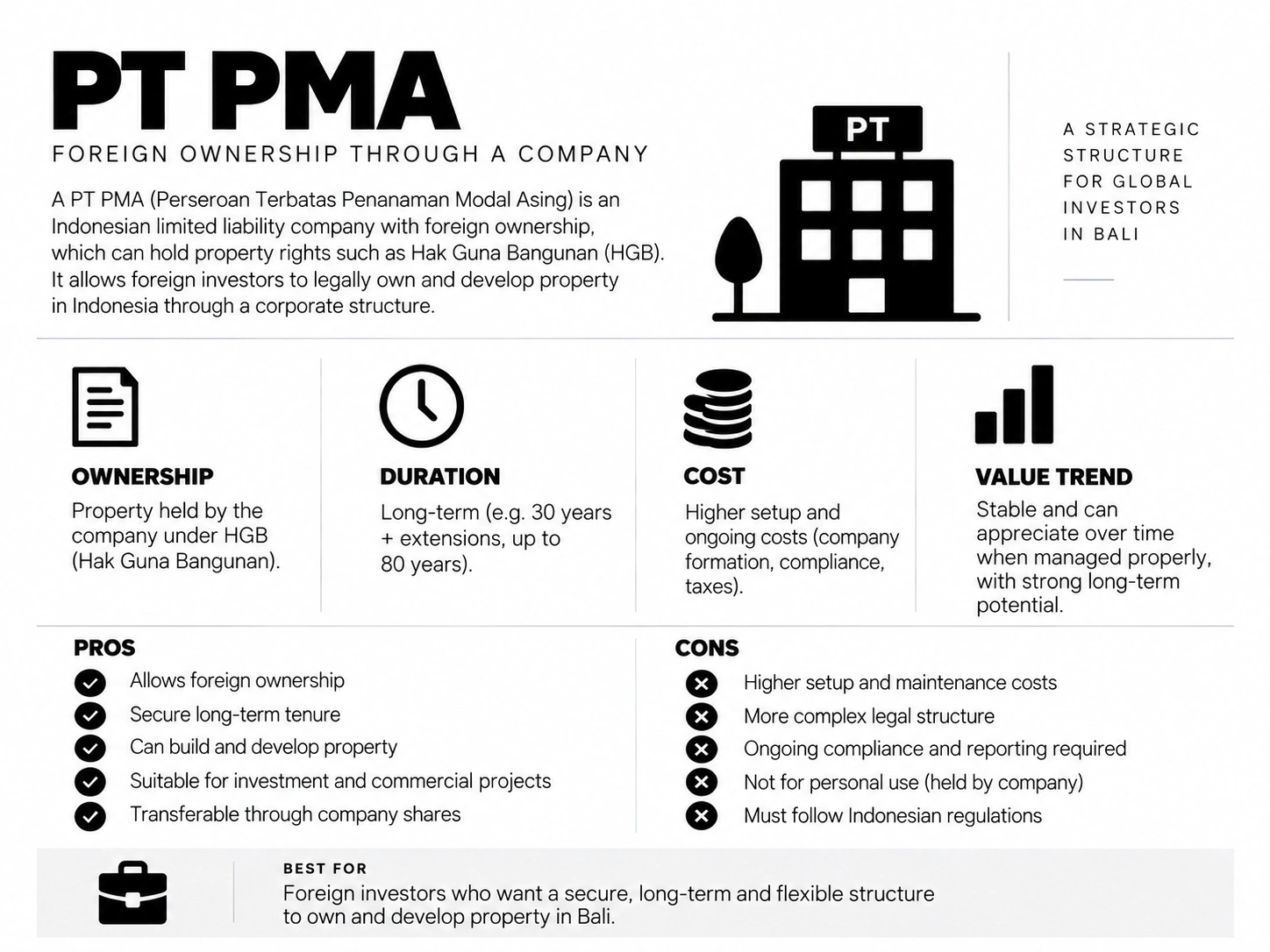
What About HGB Through a PT PMA?
A PT PMA is an Indonesian limited liability company established for foreign investment.
However, it should not be confused with a foreign individual personally holding Hak Milik.
The Indonesian investment framework permits foreign investment through qualifying Indonesian corporate structures, subject to applicable investment, business-sector and licensing requirements.
BKPM’s current investment information states that foreign investment companies are generally established as Indonesian limited liability companies, while applicable investment thresholds and sector-specific requirements need to be considered.
The exact structure should therefore be designed around the intended business.
For example, an investor developing a commercial villa project may need to consider:
Investor → PT PMA → business activity → land right → development approvals → operation → revenue → exit
rather than thinking simply:
Investor → villa → ownership.
In fact, that distinction is particularly important when the property is intended to generate commercial income.
…
Why Investors Should Not Choose the Structure First
In fact, a common mistake is asking:
“Should I use leasehold or PT PMA?”
before defining the investment.
Instead, the better sequence is:
1. What am I trying to achieve?
- Personal residence?
- Holiday home?
- Rental villa?
- Hospitality business?
- Development project?
- Long-term capital appreciation?
2. Who is the investor?
- Indonesian individual?
- Foreign individual?
- Indonesian company?
- Foreign-invested company?
3. What asset is being acquired?
- Land?
- Existing villa?
- Development site?
- Commercial property?
4. Which activity will take place there?
- Private use?
- Short-term accommodation?
- Long-term rental?
- Hospitality business?
5. What legal structure supports that objective?
Only after these questions have been answered should the appropriate legal and ownership structure be assessed.

…
The Financial Model Must Include the Lease Term
Instead, a leasehold property should not be evaluated using the same simple model that someone might use for perpetual land ownership.
For example, consider a hypothetical villa investment:
Acquisition: Rp10 billion
Remaining lease: 30 years
For instance, suppose the villa generates:
Rp800 million gross revenue per year.
Indeed, it would be misleading to simply calculate:
Rp800 million × 30 years = Rp24 billion
and call that the investment return.
In fact, there are too many variables.
In particular, the investor still needs to account for:
- occupancy;
- seasonality;
- management fees;
- platform commissions;
- staff;
- maintenance;
- utilities;
- insurance;
- taxes;
- furniture replacement;
- renovation;
- capital expenditure;
- financing;
- inflation;
- changes in nightly rates;
- downtime;
- remaining lease term;
- eventual exit value.
The investment model should therefore calculate net operating income and cash flows over time, rather than relying on gross revenue multiplied by years.

…
Leasehold ROI Should Be Viewed Through Cash Flow
In practice, a more sophisticated model might look like:
Initial investment
- Lease acquisition
- Construction / renovation
- Furniture and equipment
- Operating expenses
- Net operating income
- Maintenance and capital expenditure
- Potential resale / assignment
- Extension cost, if applicable
- Final lease expiry scenario
Overall, this gives the investor a much clearer picture of the actual economics.
For a 30-year lease, for example, the investor might need to compare:
- Scenario A: operate for 10 years and sell/assign the remaining lease.
- Alternatively, Scenario B: operate for 20 years and sell with 10 years remaining.
- In another case, Scenario C: operate until expiry.
- Finally, Scenario D: negotiate an extension before the remaining term becomes too short.
In short, each scenario can produce a different investment outcome.

…
Exit Strategy Is Critical for Leasehold
In particular, one of the biggest differences between leasehold and perpetual land ownership is the importance of the exit strategy.
Above all, an investor buying a leasehold villa should ask:
“Who will buy this from me later?”
Suppose you acquire a villa with a 30-year lease.
After operating it for 10 years, you want to sell.
On the contrary, the buyer is not acquiring a new 30-year lease.
Instead, they are acquiring approximately 20 years of remaining contractual rights, subject to the actual lease agreement.
That means the future buyer will evaluate:
- remaining lease;
- property condition;
- revenue;
- location;
- management;
- operating history;
- extension provisions;
- expected return;
- purchase price.
The remaining term can therefore directly affect the size of the future buyer pool.

…
A Shorter Lease Can Require a Different Pricing Strategy
For example, consider two otherwise similar villas.
Villa A
- Location: Uluwatu
- Remaining lease: 28 years
- Price: Rp8 billion
Villa B
- Location: Uluwatu
- Remaining lease: 12 years
- Price: Rp6 billion
At first glance, Villa B is cheaper.
But is it cheaper enough?
In fact, that is the real question.
Specifically, the investor needs to determine whether the lower acquisition price adequately compensates for:
- fewer years of operation;
- potentially weaker resale demand;
- shorter financing/economic horizon;
- upcoming extension negotiations;
- possible renovation requirements;
- uncertainty around future extension cost.
Ultimately, a cheaper leasehold property is not automatically a better investment.

…
Location Still Matters — But the Lease Changes the Equation
Indeed, this brings us back to the first article in this series.
In fact, Uluwatu is not one property market.
For instance, Bingin, Padang-Padang, Pecatu, Balangan, Ungasan and other micro-locations have different demand profiles.
Next, add another variable:
ownership or usage structure.
Two identical villas in the same neighbourhood can have different investment values if:
- one has 28 years remaining;
- the other has 12 years remaining;
- one has a clearly documented extension mechanism;
- the other has no defined extension arrangement;
- one has clean assignment rights;
- the other has restrictions on transfer.
This is why sophisticated property analysis cannot stop at:
“Where is the property?”
It must also ask:
“What exactly am I acquiring?”
…
What Investors Should Check in a Leasehold Agreement
Before entering a Bali leasehold transaction, therefore, investors should have the agreement reviewed professionally.
For instance, important points include:
Lease term
What is the exact commencement and expiry date?
Extension
Is there an extension option?
Who controls it?
How is the price determined?
Assignment
Can the lease be transferred or assigned to another investor?
Does the landowner’s consent need to be obtained?
Development rights
Does the agreement clearly allow the intended construction and use?
Existing buildings
Who owns the building and improvements during the lease?
Expiry
What happens to the villa and other improvements when the lease ends?
Default
What happens if either party breaches the agreement?
Termination
Under what circumstances can the agreement be terminated early?
Landowner obligations
What obligations does the landowner have during the lease?
Taxes and costs
Who is responsible for taxes, land-related costs, maintenance and other expenses?
Dispute resolution
What law governs the agreement and how are disputes resolved?
In fact, these clauses can be just as important as the headline lease price.

…
Do Not Compare Leasehold Prices Without Comparing Remaining Years
For example, a useful way to compare leasehold properties is to normalize the remaining term.
For example:
Property A
- Rp9 billion
- 30 years remaining
Property B
- Rp7 billion
- 15 years remaining
Instead, simply saying “Property B is Rp2 billion cheaper” does not tell the investor enough.
The investor should examine:
- Acquisition cost
- Development cost
- Operating cost
- Expected net cash flow
- Expected exit value
- Extension assumptions
over the remaining lease period.
Ultimately, this produces a much more meaningful comparison.

…
The “Rp10 Billion Villa” May Not Be a Rp10 Billion Asset Forever
In fact, this is perhaps the most important idea in this article.
If an investor says:
“I own a Rp10 billion villa.”
in fact, the statement may hide an important question:
“What exactly makes up that Rp10 billion?”
Is it:
- land ownership?
- a leasehold interest?
- a building?
- furniture?
- a business?
- a combination of contractual rights and physical assets?
Indeed, the economic value of each component behaves differently.
- A leasehold interest has a finite life.
- In addition, a building depreciates physically and requires maintenance.
- Similarly, a business depends on revenue and operating performance.
- Meanwhile, a location can appreciate or decline.
Therefore, the investment should be evaluated as a bundle of economic rights and assets, rather than as one simple number.

…
A Better Way to Think About Leasehold
Instead of thinking:
“I bought a villa.”
think:
“I acquired a time-limited economic interest in a property and its associated rights.”
Consequently, that mindset changes the questions an investor asks.
Then, you begin asking:
- How long is left?
- What are my rights?
- What are my obligations?
- Can I transfer the interest?
- Can I extend it?
- How much could the extension cost?
- What happens at expiry?
- Who is likely to buy the remaining interest from me?
- Does the expected cash flow justify the acquisition price?
Those are much more useful investment questions.

…
Leasehold Does Not Mean Bad Investment
It is also important not to misunderstand the point.
In fact, this article is not arguing that leasehold is inherently inferior.
Specifically, leasehold can be a rational investment structure when:
- the location is strong;
- or the acquisition price is appropriate;
- the lease term is sufficient;
- or the property has strong revenue potential;
- the contract is properly structured;
- development and operating rights are clear;
- the exit strategy is realistic;
- the investor’s expected return justifies the remaining term.
In some circumstances, a well-structured leasehold investment can provide an attractive entry point into a high-demand market without requiring the investor to acquire perpetual land ownership.
The question is not:
“Is leasehold good or bad?”
Instead, the better question is:
“Does this particular leasehold structure make economic sense for this particular investment?”

…
A Leasehold Investment Checklist
Therefore, before committing to a leasehold property in Bali, investors should review:
LEGAL
- What exactly is being acquired?
- Who owns the underlying land?
- What contractual rights are granted?
- Has the agreement been professionally reviewed?
TIME
- When does the lease start?
- When does it expire?
- How many years remain?
EXTENSION
- Is extension provided for?
- Is it an option or simply a possibility?
- How will the price be determined?
PROPERTY
- Who owns the building?
- What happens to improvements at expiry?
- What construction rights exist?
OPERATION
- Can the property legally be used for its intended purpose?
- What business/licensing requirements apply?
TRANSFER
- Can the lease be assigned?
- Can the property be sold to another investor?
- Is landlord consent required?
FINANCIAL
- Acquisition price
- Construction cost
- Operating cost
- Net cash flow
- Remaining lease term
- Exit value
- Potential extension cost
 …
…
How PW Developments Approaches Property Investment
At PW Developments, we therefore believe investors should understand the structure behind a property before evaluating its headline price.
A villa in Bali is not simply:
Land + Building = Investment
The actual investment may involve:
Location + Land Rights + Contractual Rights + Development + Business Activity + Revenue + Operating Costs + Remaining Term + Exit Strategy
Indeed, this is particularly important when considering leasehold property in Uluwatu and other high-demand areas of Bali.
For investors, the objective should be to understand what is actually being acquired and whether the expected economic return justifies the structure.
Put simply, that means looking beyond the villa itself.
It also means examining the legal framework, remaining term, development rights, operational model and eventual exit.

…
Final Thoughts
A Time-Limited Right, Not Permanent Ownership
Leasehold can be a legitimate and useful structure for property investment in Bali.
But it should never be presented to an investor as if it were identical to permanent land ownership.
If the underlying land is not being transferred to you under a permanent ownership right, then what you are acquiring is a time-limited right or interest, depending on the structure.
Overall, that distinction becomes increasingly important as the remaining term decreases.
- A 30-year lease is not economically identical to a 15-year lease.
- A 15-year lease is not economically identical to a 5-year lease.
And a lease with a clearly defined extension mechanism is not necessarily equivalent to one where “extension may be possible” is merely an informal statement.
Questions Every Investor Should Ask
For serious Bali property investors, the right questions are therefore:
- What am I acquiring?
- How long do I have the right to use it?
- What happens when the term ends?
- Can I extend or transfer it?
- What will another investor pay for the remaining term?
And most importantly:
Does the expected return justify the structure and the remaining lease period?
In fact, understanding these questions before signing a property agreement is not simply legal housekeeping.
It is fundamental investment analysis.
Published by Marketing Team of Pillai Ward
1. Law No. 5 of 1960 — Basic Agrarian Law (UUPA)
Specifically, this is the foundational legislation for Indonesia’s land-rights framework, including the provisions governing Hak Milik.
BPK Legal Database — Law No. 5 of 1960
2. Government Regulation No. 18 of 2021 — Land Rights and Registration
Moreover, this is one of the most important current references for Hak Pengelolaan, Hak Atas Tanah, Hak Pakai, HGB and related land-registration matters. It remains in force.
BPK Legal Database — PP No. 18 of 2021
3. PP No. 18/2021 — Hak Pakai provisions
Importantly, the regulation expressly includes foreigners among the potential holders of Hak Pakai with a term, subject to the applicable requirements.
4. Ministry of Investment and Downstream Industry / BKPM
Useful for explaining the broader framework around foreign investment and PT PMA structures.
BKPM — Investment Prospects and Foreign Investment
5. Ministry of Agrarian Affairs / BPN framework
Specifically, the applicable procedures for establishing land rights are further regulated by Permen ATR/BPN No. 18 of 2021.
BPK Legal Database — Permen ATR/BPN No. 18 of 2021
Thank you.