
PW Developments — When investors hear the words “Uluwatu property investment,” it is easy to think of Uluwatu as one single real estate market.
In reality, it is much more complicated.
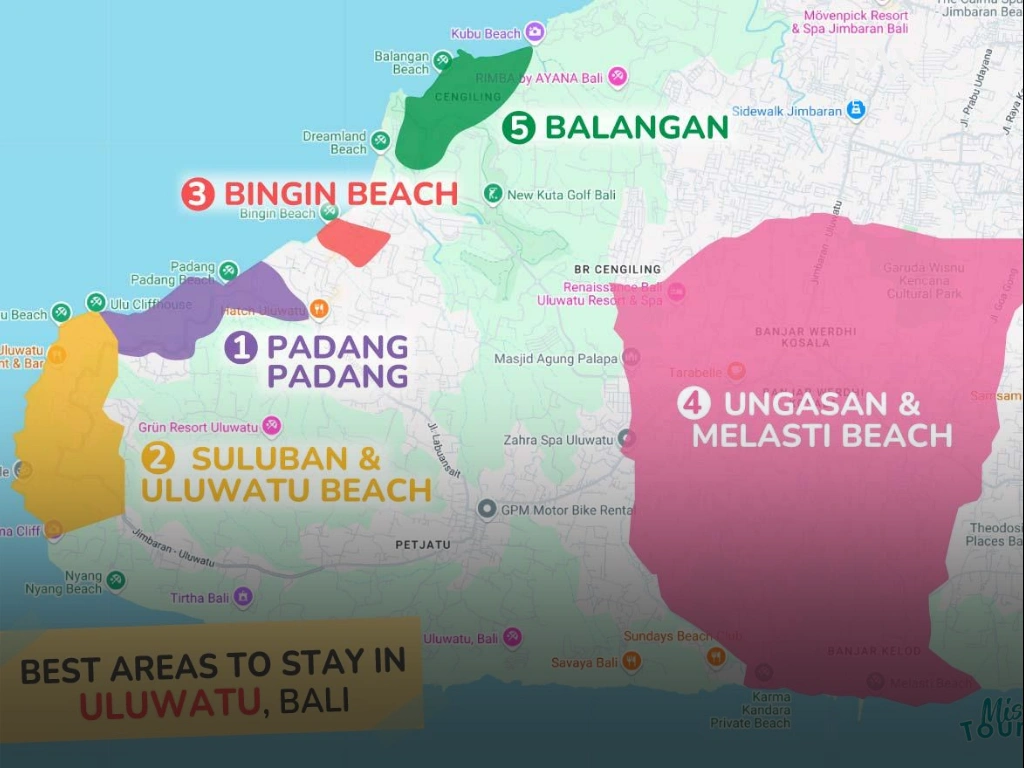
The southern Bukit Peninsula contains a number of distinct micro-areas, including Bingin, Padang-Padang, Pecatu, Balangan, Ungasan, Nyang Nyang, and the areas surrounding Melasti.
In fact, each location has its own characteristics.
The differences can influence:
- land values
- visitor profiles
- rental demand
- achievable nightly rates
- development density
- accessibility
- surrounding infrastructure
- property positioning
- operating costs
- future resale or lease-assignment potential
This is why asking:
“Is Uluwatu a good place to invest?”
is not necessarily the most useful question.
A better question is:
“Which part of Uluwatu, for what type of property, targeting which market, with what ownership structure and investment strategy?”
That distinction can have a significant impact on the outcome of a property investment.

…
Why Uluwatu Continues to Attract International Demand
Bali remains one of Southeast Asia’s most established international tourism markets.
According to Indonesia’s official statistics agency, BPS-Statistics Indonesia, Bali recorded 6,948,754 direct international tourist arrivals during January–December 2025, representing a 9.72% increase compared with 2024. Australia remained the largest source market, accounting for 23.44% of arrivals.
As a result, the broader tourism market creates an important foundation for hospitality-oriented real estate.
However, strong tourism numbers do not automatically mean that every property in every location will perform equally well.
Tourists do not consume “Bali” as one homogeneous product.
They choose specific locations based on what they want from their stay.
Some want surfing.
Many want beach clubs and restaurants.
Others seek privacy.
And some want wellness and longer stays.
Others prioritize accessibility, larger villas, or proximity to major attractions.
This is where Uluwatu’s micro-market structure becomes important.

…
Uluwatu’s Micro-Locations Have Different Investment Characteristics
1. Bingin: Lifestyle, Surf and Short-Term Rental Demand
For instance, Bingin has developed a strong identity around surfing, lifestyle tourism, boutique accommodation, restaurants and a more intimate coastal atmosphere.
In other words, its appeal is closely connected to the experience of staying in Bingin rather than simply being close to a beach.
For investors, this can make Bingin attractive for products positioned around:
- boutique villas
- design-led accommodation
- short-term rentals
- surf-oriented stays
- couples and younger international travelers
- lifestyle-driven hospitality
Indonesia’s official tourism platform describes Bingin as a destination associated with a more relaxed atmosphere while maintaining strong appeal for surfers.
But high demand does not eliminate risk.
Coastal locations can involve additional considerations around land status, access, setbacks, zoning and development permissions.
In other words, the closer a property is to a highly desirable location, the more important due diligence becomes.
2. Padang-Padang: Established Tourism and Surf Culture
Likewise, Padang-Padang is another location with a strong tourism identity.
Specifically, the area is associated with one of Bali’s best-known beaches and a long-established surf culture. Indonesia Travel notes that Padang-Padang attracts both experienced surfers and visitors looking for a more accessible beach experience.
From an investment perspective, locations with an established tourism identity can have an important advantage:
the market already understands why people want to stay there.
That can help properties positioned for:
- short-term vacation rentals
- boutique villas
- couples
- surf tourism
- lifestyle stays
However, investors should not assume that proximity to Padang-Padang automatically guarantees high occupancy or high nightly rates.
The property itself still matters.
Architecture, privacy, pool design, bedroom configuration, views, access, management and guest experience all influence performance.
3. Pecatu: Accessibility, Space and Development Potential
Pecatu is particularly interesting because it is not defined solely by a single beach.
Additionally, it provides access to several important destinations across the Bukit Peninsula while offering a different development environment from the most concentrated coastal hotspots.
For investors, this can create opportunities for larger residential or villa concepts where land availability, plot size and accessibility become more important than being directly beside a famous beach.
Pecatu may therefore suit products designed around:
- larger villas
- private residences
- family-oriented accommodation
- wellness concepts
- long-stay visitors
- mixed personal-use and rental strategies
Again, the key consideration here is not simply distance from the ocean.
Instead, it is the relationship between land price, accessibility, development potential, property size and achievable revenue.
A property that is slightly farther from the beach may sometimes produce a better investment structure if the investor obtains significantly more usable land or a better development configuration.
4. Balangan: Surf, Beach Lifestyle and Growing Interest
Balangan has its own tourism identity, particularly around surfing and beach-oriented travel.
It also occupies an interesting position within the wider Bukit Peninsula because it can provide access to the southern Bali lifestyle market while remaining distinct from the more concentrated Uluwatu and Bingin environments.
As a result, this makes Balangan worth considering for investors looking for:
- villa developments
- surf-oriented accommodation
- lifestyle properties
- boutique hospitality
- longer-term development opportunities
Here too, the investment question should again focus on the relationship between entry price and potential revenue, rather than simply asking whether Balangan is “popular.”
5. Ungasan and Melasti: Residential and Premium Lifestyle Positioning
By contrast, Ungasan has a different character from the more surf-centric coastal pockets.
The area can appeal to investors looking for larger properties, residential environments and premium lifestyle positioning, particularly around destinations such as Melasti.
This creates potential opportunities for:
- luxury villas
- family accommodation
- private residences
- wellness properties
- premium vacation rentals
For some investors, this type of environment may be more attractive than being directly inside a high-density surf destination.
The trade-off is that the investment thesis may depend more heavily on property quality, accessibility, design, privacy and the overall guest experience.
6. Nyang Nyang: Less Mature, Potentially More Long-Term
In contrast, Nyang Nyang represents another type of investment proposition.
Compared with established hotspots, less mature areas may offer different entry points and development opportunities.
But investors should understand the fundamental trade-off:
lower entry pricing does not automatically mean higher returns.
In practice, an emerging location may require:
- more patience
- stronger development planning
- better access analysis
- infrastructure assessment
- more careful market positioning
- a longer investment horizon
Instead, the opportunity may come from future area development rather than immediate rental performance.
That makes Nyang Nyang potentially more relevant for investors with a longer-term view rather than investors looking purely for immediate short-term rental income.

…
The Same Villa Can Perform Differently in Different Locations
Often, one of the biggest mistakes investors can make is looking at a villa as an isolated asset.
Rather, a villa is part of a larger ecosystem.
Consider two hypothetical properties.
Villa A
- 2 bedrooms
- 150 m²
- close to a major surf destination
- limited land
- strong short-term rental positioning
Villa B
- 3 bedrooms
- 250 m²
- larger plot
- further from the beach
- better suited to families and longer stays
Which one is the better investment?
In fact, there is no universal answer.
For example, Villa A might achieve stronger nightly rates because of its location and guest profile.
Conversely, Villa B might generate stronger total revenue from larger groups and longer stays.
Alternatively, Villa B might have a lower occupancy rate but a higher average booking value.
This is why comparing properties based only on price per square meter or distance to the beach can be misleading.
Investors need to understand the entire operating model.

…
Location Should Be Matched With the Target Guest
Ultimately, a strong property investment starts with the customer.
Before deciding what to build, an investor should understand who is expected to rent the property.
For example:
| Target Guest | Location Characteristics | Potential Product |
|---|---|---|
| Surfers | Close to surf breaks | Compact villa / boutique stay |
| Couples | Lifestyle, restaurants, beaches | 1–2 bedroom villa |
| Families | Space, privacy, accessibility | 3–4 bedroom villa |
| Digital nomads | Connectivity, cafes, longer stays | Flexible residential villa |
| Luxury travelers | Privacy, views, premium amenities | High-end villa |
| Wellness travelers | Quiet environment, nature | Wellness-oriented villa |
| Mixed-use owners | Lifestyle + rental demand | Flexible residential villa |
This leads to a simple investment principle:
Do not choose the property first and search for the market afterward. Define the market first, then design the property around it.

…
Achievable Nightly Rate Is Not the Same as Revenue
Another common mistake in Bali property investment is focusing heavily on the advertised nightly rate.
Suppose a villa can theoretically achieve a nightly rate of $300.
That does not mean the property generates $109,500 per year.
The calculation needs to consider occupancy.
For example:
$300 × 60% occupancy × 365 days = $65,700 gross annual room revenue.
From there, the investor still needs to consider:
- management fees
- OTA commissions
- cleaning
- maintenance
- utilities
- staffing
- taxes
- repairs
- replacement of furniture and equipment
- marketing
- insurance
- periods of vacancy
Therefore, gross revenue is not the same as net investment return.
Consequently, this is particularly important when comparing different micro-locations in Uluwatu.

…
Accessibility Can Be More Important Than Distance
A property being “1 kilometer from the beach” sounds attractive.
But distance alone does not tell the entire story.
Investors should examine:
- road width
- road condition
- vehicle access
- parking
- traffic
- walking access
- emergency access
- proximity to restaurants
- access to supermarkets
- access to healthcare
- internet availability
- electricity reliability
- water supply
For instance, two properties can both be 1 kilometer from Bingin Beach but offer completely different guest experiences.
For a short-term rental business, accessibility can directly influence reviews, guest satisfaction and repeat bookings.
…
Zoning and Development Regulations Should Be Part of the Investment Thesis
This is one of the most important points for anyone considering Bali real estate.
However, a beautiful piece of land is not necessarily a suitable development site.
Bali’s spatial planning framework is governed by formal regional planning regulations. The Bali Provincial Spatial Plan 2023–2043 (RTRW Bali) was established through Provincial Regulation No. 2 of 2023.
More importantly for Uluwatu investors, Badung Regency adopted its updated Regional Spatial Plan for 2025–2045 through Regulation No. 4 of 2025. The regulation covers spatial structure, spatial patterns, utilization controls and related planning provisions.
Bali’s spatial planning authority also explains that tourism zoning can include accommodation, tourism facilities, recreation and ecotourism, but these activities remain subject to the applicable spatial-planning framework.
Therefore, investors should never evaluate land based solely on:
“This area is popular with tourists.”
Instead, the more important question is:
“What can legally and practically be developed on this particular plot?”

…
The Legal Structure Matters as Much as the Location
For international investors, the investment structure is another fundamental consideration.
A property investment in Bali is not simply a matter of purchasing a piece of land and building a villa.
Depending on the investor, intended use and business model, different legal structures may be relevant.
These can include structures such as:
- Leasehold
- Hak Pakai
- HGB through an appropriate Indonesian corporate structure
- PT PMA arrangements for qualifying business activities
In every case, the appropriate structure should always be reviewed with qualified Indonesian legal, tax and notarial professionals.
Investors should also distinguish between owning or controlling a property interest and operating a hospitality business.
In short, the two are not necessarily the same.
For example, Indonesia’s OSS business classification system recognizes villa accommodation as a specific business activity under KBLI 55193 in the 2020 classification framework.
The current OSS system also contains the newer KBLI 2025 framework for accommodation activities.
This is why the investment structure should be determined before the transaction is finalized, rather than after the property has already been acquired.

…
What Investors Should Check Before Buying in Uluwatu
A practical Uluwatu property due-diligence process should include at least seven major areas.
1. Location
Understand the exact micro-location, not simply the word “Uluwatu.”
2. Land and title
Verify the land certificate, ownership, encumbrances, boundaries and access.
3. Zoning
Confirm the applicable spatial planning and permitted land use.
4. Development feasibility
Determine what can realistically be built on the land.
5. Revenue potential
Model realistic occupancy, nightly rates and seasonality.
6. Operating costs
Calculate management, utilities, maintenance, staffing, taxes and other recurring costs.
7. Exit strategy
Ask how the asset could be sold, transferred or assigned in the future.
In the end, a good investment is not only about how much money it can generate.
It is also about how easily the investor can protect, operate and eventually exit the asset.

…
A Better Way to Compare Uluwatu Investment Opportunities
Instead of ranking areas simply from “best” to “worst,” investors can create a location scorecard.
For example:
| Investment Factor | Bingin | Padang-Padang | Pecatu | Balangan | Ungasan | Nyang Nyang |
|---|---|---|---|---|---|---|
| Tourism identity | High | High | High | High | High | Emerging |
| Surf/lifestyle demand | Very High | High | High | High | Medium | Medium |
| Space availability | Lower | Lower | Higher | Medium | Higher | Higher |
| Development potential | Site dependent | Site dependent | Potentially higher | Site dependent | Potentially higher | Longer-term |
| Short-term rental suitability | High | High | High | High | Medium–High | Site dependent |
| Premium residential potential | High | High | High | Medium–High | High | Emerging |
| Infrastructure sensitivity | High | High | Medium | Medium | Medium | Higher |
This is not a substitute for professional market research or property-specific due diligence.
It is simply a framework for understanding why micro-location matters.

…
The Most Important Question Is Not “Is Uluwatu a Good Investment?”
Uluwatu can offer compelling opportunities because it combines international tourism demand, surf culture, lifestyle destinations, premium coastal environments and continued development across the southern Bukit Peninsula.
But that does not mean every property in Uluwatu is a good investment.
The investment outcome depends on a combination of factors:
Location + Land + Product + Target Market + Revenue Model + Legal Structure + Development Quality + Management + Exit Strategy
Indeed, changing just one of those variables can materially change the investment case.
For example, a cheaper property in the wrong location can underperform an expensive property in the right location.
Similarly, a beautiful villa with poor access can struggle.
Likewise, a high nightly rate with low occupancy can produce disappointing annual revenue.
And an attractive piece of land with unsuitable zoning can become a significant liability.

…
How PW Developments Approaches Property Investment in Bali
At PW Developments, we believe investors should understand the fundamentals behind a property before making an investment decision.
In practice, that means looking beyond the villa itself.
The location, intended market, legal structure, land due diligence, development feasibility, construction, operational strategy and eventual exit should all form part of the conversation.
PW Developments’ investment framework includes considerations around ownership structures, land and title checks, zoning, access, development compliance, construction, rental operations and exit planning.
As a result, this approach is particularly important in markets such as Uluwatu, where different micro-locations can produce very different investment propositions.
The objective should not simply be to find a property in a popular destination.
It should be to find the right asset for the right market with the right structure.

…
Final Thoughts
Uluwatu should not be viewed as one uniform property market.
Bingin is not the same as Padang-Padang.
Padang-Padang is not the same as Pecatu.
In the same way, Pecatu is not the same as Ungasan.
And an investment opportunity in Balangan or Nyang Nyang may require an entirely different investment thesis.
For investors entering Bali real estate, this distinction is critical.
The strongest question is not:
“Is Uluwatu good for property investment?”
It is:
“Which part of Uluwatu, for which product, targeting which market, with what investment structure and what exit strategy?”
Ultimately, that is where serious property analysis begins.
If you are evaluating a property investment opportunity in Bali, the team at PW Developments can help you understand the investment from location selection and legal structure through development and long-term asset strategy.
Explore PW Developments’ Bali Investment Guide
Published by
Marketing Team of Pillai Ward
- Tourism and market data
- Spatial planning and regulation
- Business classification
Thank you.